
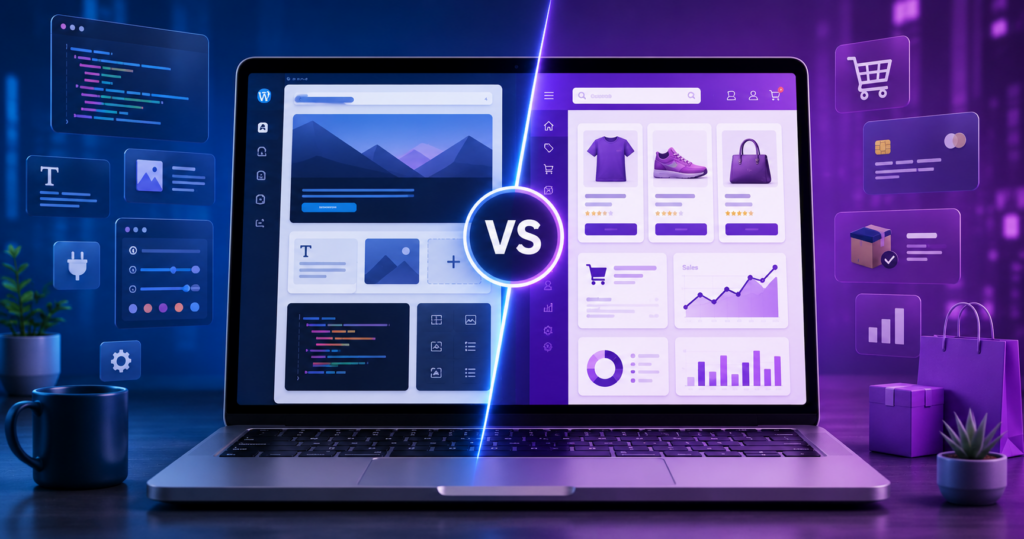
Choosing the right platform is one of the most important decisions you’ll make when building a website or online store.
Two names that you’ll frequently encounter are WordPress and Shopify.
Both are powerful platforms, but they are designed with different priorities. Shopify focuses heavily on making eCommerce simple, while WordPress gives website owners considerably more flexibility and control, especially when combined with WooCommerce.
So, when comparing WordPress vs Shopify, which one should you choose in 2026?
The answer depends on what you’re building, your technical requirements, your budget, and how much control you want over your website.
In this detailed comparison, we’ll examine WordPress and Shopify based on ease of use, eCommerce functionality, customization, pricing, SEO, performance, security, scalability, maintenance, and more.
By the end, you should have a much clearer idea of which platform fits your business.
WordPress vs Shopify: Quick Comparison
Before getting into the details, here’s a simple overview.
| Feature | WordPress + WooCommerce | Shopify |
|---|---|---|
| Ease of Use | Moderate | Very Easy |
| Customization | Excellent | Good |
| eCommerce | Excellent | Excellent |
| SEO Control | Excellent | Good |
| Hosting | Choose your own | Included |
| Maintenance | User managed | Mostly managed |
| Blogging | Excellent | Good |
| Ownership & Control | Very High | Platform dependent |
| Apps/Plugins | Huge ecosystem | Large app ecosystem |
| Best For | Flexible websites & custom stores | Easy-to-manage online stores |
Neither platform wins every category.
The better choice depends on your requirements.
What Is WordPress?
WordPress is an open-source content management system used to build everything from blogs and company websites to membership platforms and large eCommerce stores.
For eCommerce, WordPress is commonly combined with WooCommerce.
WooCommerce adds features such as:
- Products
- Shopping carts
- Checkout
- Orders
- Payment gateways
- Shipping
- Coupons
- Customer accounts
- Inventory management
One of WordPress’s biggest advantages is flexibility.
You can choose your hosting provider, theme, plugins, SEO tools, caching solution and even modify the underlying code when necessary.
This makes WordPress particularly attractive to businesses that need more than a standard online store.
What Is Shopify?
Shopify is a hosted eCommerce platform designed specifically for selling products online.
Unlike WordPress, you don’t normally need to arrange separate hosting or manually manage the underlying server.
Shopify provides much of the essential infrastructure required to operate an online store.
You can manage:
- Products
- Orders
- Inventory
- Payments
- Shipping
- Discounts
- Customers
- Analytics
- Store design
from one platform.
This makes Shopify attractive to business owners who want to start selling without dealing with many of the technical responsibilities associated with managing their own website infrastructure.
WordPress vs Shopify: Detailed Comparison
1. Ease of Use
Shopify
Shopify is generally easier for beginners.
After creating an account, you can choose a theme, add products, configure payments and begin building your store.
Many technical responsibilities are handled by the platform.
You don’t have to separately manage:
- Hosting
- Core platform updates
- Server configuration
- Many infrastructure-related security tasks
For business owners without development experience, this can be a major advantage.
WordPress
WordPress requires more initial setup.
You’ll typically need:
- A domain
- Web hosting
- WordPress installation
- A theme
- Required plugins
- WooCommerce for an online store
Modern hosting providers have made WordPress installation considerably easier, but it still provides more choices and therefore requires more management.
Winner: Shopify
For pure ease of use, Shopify has the advantage.
2. Design and Customization
Customization is where WordPress becomes particularly powerful.
WordPress
WordPress gives you access to thousands of themes and plugins.
Developers can also create:
- Custom themes
- Custom plugins
- Custom checkout functionality
- Advanced integrations
- Custom post types
- Unique customer portals
- Membership functionality
- Advanced business workflows
You also have considerably more access to the code and database.
Shopify
Shopify also provides professional themes and strong customization options.
Its theme architecture allows developers to build highly polished online stores.
However, because Shopify is a hosted platform, certain areas of the platform remain controlled by Shopify.
For a standard online store this usually isn’t a problem.
For highly customized business requirements, WordPress can provide greater flexibility.
Winner: WordPress
If complete customization is your priority, WordPress is usually the stronger option.
3. eCommerce Features
This category is extremely close.
Shopify
Shopify was designed specifically for commerce.
It provides essential store functionality including:
- Product management
- Inventory
- Checkout
- Payments
- Shipping
- Discount codes
- Customer accounts
- Analytics
- Order management
Additional functionality can be installed through Shopify’s app ecosystem.
WordPress + WooCommerce
WooCommerce transforms WordPress into a powerful eCommerce platform.
You can sell:
- Physical products
- Digital products
- Subscriptions
- Memberships
- Bookings
- Services
- Courses
- Custom products
WooCommerce’s biggest advantage is flexibility.
You can modify almost every part of the store when you have the necessary development expertise.
Winner: Tie
Choose Shopify for simplicity and WooCommerce for flexibility.
4. WordPress vs Shopify for SEO
SEO is essential if you want customers to discover your website through Google and other search engines.
WordPress SEO
WordPress gives website owners extensive control over SEO.
Depending on your setup, you can control:
- SEO titles
- Meta descriptions
- URLs
- Schema markup
- XML sitemaps
- Redirects
- Canonical URLs
- Image optimization
- Internal linking
- Robots directives
Popular SEO plugins can make many of these tasks easier.
WordPress is also extremely strong for content marketing because blogging is a core part of the platform.
Shopify SEO
Shopify includes many essential SEO features and can rank successfully in search engines.
You can optimize areas such as:
- Page titles
- Meta descriptions
- Product content
- Image alt text
- Redirects
- Blog content
However, WordPress generally provides developers and advanced SEO professionals with more control over website architecture and technical customization.
Winner: WordPress
For businesses prioritizing advanced SEO and content marketing, WordPress has an advantage.
5. Blogging and Content Marketing
A strong blog can help your business attract customers through informational searches.
WordPress originally started as a blogging platform and has evolved into a complete CMS.
You can easily create:
- Blog posts
- Categories
- Tags
- Author archives
- Custom content types
- Landing pages
- Content hubs
Shopify also includes blogging functionality, which is sufficient for many stores.
However, businesses planning a large content marketing strategy will generally find WordPress more flexible.
Winner: WordPress
6. Pricing
Comparing WordPress vs Shopify pricing isn’t as simple as comparing two monthly prices.
WordPress Costs
WordPress itself is open source, but running a professional website can involve costs for:
- Domain
- Hosting
- Premium themes
- Premium plugins
- Security
- Backups
- Development
- Maintenance
You have significant control over these costs.
A small website can be inexpensive, while a heavily customized eCommerce platform can cost significantly more.
Shopify Costs
Shopify works primarily through subscription plans.
Depending on your setup, costs may include:
- Monthly Shopify subscription
- Premium themes
- Paid apps
- Payment processing
- Transaction-related fees
- Custom development
Shopify’s predictable platform pricing can make budgeting easier.
Winner: Depends
WordPress offers greater cost flexibility, while Shopify offers a more predictable managed platform model.
7. Apps vs Plugins
Both ecosystems offer thousands of extensions.
WordPress Plugins
WordPress plugins can add functionality such as:
- SEO
- Security
- Backups
- Forms
- Memberships
- Booking systems
- Analytics
- Performance optimization
- Payment gateways
- Marketing automation
WooCommerce also has its own large extension ecosystem.
Shopify Apps
The Shopify App Store offers solutions for:
- Email marketing
- Reviews
- Upselling
- Dropshipping
- Subscriptions
- Customer service
- Analytics
- Inventory
- Shipping
- Conversion optimization
Winner: WordPress for flexibility
Both ecosystems are excellent, but WordPress provides particularly broad extensibility beyond eCommerce.
8. Website Performance
Both WordPress and Shopify can provide fast websites when configured correctly.
Shopify Performance
Because Shopify controls the hosting infrastructure, many performance-related responsibilities are managed for you.
However, installing too many apps or using a poorly optimized theme can still affect storefront performance.
WordPress Performance
WordPress performance depends heavily on your setup.
Important factors include:
- Hosting quality
- Theme quality
- Plugin selection
- Image optimization
- Caching
- Database optimization
- CDN configuration
- Custom code
A properly optimized WordPress website can be extremely fast, but poor configuration can also result in a slow website.
Winner: Shopify for easier management
Shopify makes performance management easier for non-technical users.
WordPress provides more optimization control.
9. Security
Security is critical for any website, especially one processing customer orders.
Shopify
Shopify manages much of the infrastructure and platform security.
This reduces the technical workload for store owners.
WordPress
With WordPress, security depends more heavily on how your website is maintained.
You need to consider:
- WordPress updates
- Plugin updates
- Theme updates
- Backups
- Hosting security
- Malware protection
- User permissions
- Strong passwords
A properly maintained WordPress website can be secure, but the owner or development team has more responsibility.
Winner: Shopify for simplicity
Shopify makes security easier for business owners who don’t want to manage technical maintenance themselves.
10. Maintenance
Shopify handles much of the underlying platform maintenance.
WordPress gives you more control but requires more responsibility.
With WordPress, you should regularly:
- Update plugins
- Update themes
- Update WordPress
- Monitor backups
- Test functionality
- Check website security
- Monitor performance
This isn’t necessarily a disadvantage.
For businesses with a developer or maintenance team, the additional control can be valuable.
11. Scalability
Both platforms can support growing businesses.
Shopify makes infrastructure scaling relatively straightforward because the hosting environment is managed.
WordPress and WooCommerce can also support significant traffic and large stores, but scalability depends on architecture, hosting, caching, database performance and development quality.
Winner: Both
Both can scale, but they take different approaches.
WordPress vs Shopify for Small Businesses
For small businesses, the decision usually comes down to simplicity versus flexibility.
Choose Shopify when your primary goal is:
“I want to start selling products online quickly.”
Choose WordPress when your goal is closer to:
“I need a complete business website that may include eCommerce, blogging, SEO, custom functionality and future expansion.”
When Should You Choose WordPress?
WordPress may be the better option if you want:
- Maximum website control
- Advanced customization
- Strong blogging capabilities
- Extensive SEO control
- Custom business functionality
- WooCommerce
- Membership functionality
- Booking systems
- Custom integrations
- Greater control over hosting
It’s particularly suitable when your website needs to become more than just an online store.
When Should You Choose Shopify?
Shopify may be the better choice if you want:
- Fast store setup
- Simple administration
- Managed hosting
- Built-in commerce functionality
- Less technical maintenance
- An established app ecosystem
- A platform focused primarily on selling
It’s particularly attractive to businesses whose main objective is running an online store without managing much of the underlying technology.
WordPress vs Shopify: Which Is Better for SEO?
If SEO and content marketing are central to your long-term strategy, WordPress generally provides more flexibility and control.
However, this does not mean Shopify websites cannot rank well.
Successful SEO depends heavily on:
- Content quality
- Search intent
- Website structure
- Page speed
- Product information
- Internal linking
- Backlinks
- User experience
- Technical implementation
The platform is only one part of a successful SEO strategy.
Can You Use WordPress and Shopify Together?
Yes.
Some businesses use WordPress for their primary content website while using Shopify for commerce.
However, this architecture adds complexity and isn’t necessary for most businesses.
Before using multiple platforms, consider whether the benefits justify the additional development, analytics, SEO and maintenance requirements.
WordPress vs Shopify: Final Verdict
There isn’t one universal winner.
Choose WordPress if:
You want flexibility, customization, content marketing, SEO control and the freedom to build advanced functionality.
Choose Shopify if:
You want a streamlined, managed eCommerce platform that lets you concentrate on selling products rather than managing website infrastructure.
For many small businesses that primarily want to sell products, Shopify can be the easier starting point.
For businesses that need a flexible website combining services, content, SEO, eCommerce and custom functionality, WordPress can be the stronger long-term choice.
The best platform is ultimately the one that supports your business model, budget, technical requirements and future growth plans.
Frequently Asked Questions
Is WordPress better than Shopify?
Neither platform is universally better. WordPress offers greater customization and control, while Shopify provides a simpler managed eCommerce experience.
Is Shopify easier than WordPress?
For most beginners building an online store, Shopify is generally easier because hosting and much of the technical infrastructure are managed by the platform.
Is WordPress good for eCommerce?
Yes. WordPress combined with WooCommerce can be used to create powerful and highly customizable eCommerce websites.
Which is better for SEO: Shopify or WordPress?
Both can perform well in search engines, but WordPress generally provides more flexibility for advanced SEO, website architecture and content marketing.
Is WordPress cheaper than Shopify?
It depends on the website. WordPress gives you more flexibility over hosting, themes and plugins, while Shopify uses subscription plans and may involve additional app and transaction-related costs.
Can I move from Shopify to WordPress later?
Yes. Products, customers and other store data can be migrated, but the complexity depends on the size of the store, theme, apps, URLs and custom functionality.
Can I move from WordPress to Shopify?
Yes. Businesses can migrate from WooCommerce to Shopify, although proper planning is important to preserve product data, URLs, SEO value and customer information.
Conclusion
The WordPress vs Shopify decision shouldn’t be based simply on which platform is more popular.
Start with your business requirements.
If you need an easy-to-manage platform focused primarily on eCommerce, Shopify is an excellent option.
If you need greater control over your website, extensive customization, advanced content management, SEO flexibility and the ability to build custom functionality, WordPress with WooCommerce may be the better solution.
A platform should support your business rather than restrict its future growth.
Before choosing, consider what your website needs today and what your business may need two or three years from now.
Choosing the right platform is only the beginning. Your website also needs a strong search strategy. Read our guide on What Is SEO and Why Does Your Website Need It? to understand how organic search can help your business grow.
WordPress is an open-source publishing platform with a large ecosystem of themes, plugins and development tools. Businesses considering the platform can learn more about its features and ecosystem from the official WordPress website.